WHAT IS THE IN-SILICO DRUG REPURPOSING CATALOGUE?
Created by REMEDi4ALL, the REMEDi4ALL In-silico drug repurposing catalogue (iDRC-REMEDi4ALL) is an online collection of 178 relevant tools, databases and methods which are related to the drug repurposing pathway
WHO IS iDRC-REMEDi4ALL FOR?
Academic researchers and industry professionals looking for scientific information relating to drug repurposing

WHY IS iDRC-REMEDi4ALL USEFUL?
The catalogue combines a wide variety of databases on small molecules with patient databases and disease interactions into a single platform of relevant, open access drug repurposing resources for academic and industry applications.
WHAT RESOURCES ARE AVAILABLE IN THE CATALOGUE?
The catalogue compiles open access databases on: patient data, drug-target interactions, activity and disease interactions, links between genes and diseases, cell lines, protein and chemical structures, pathways and toxicities. The catalogue also houses tools and methods on docking, modelling, binding sites and predictions.


HOW TO USE THE REMEDi4ALL IN-SILICO DRUG REPURPOSING CATALOGUE
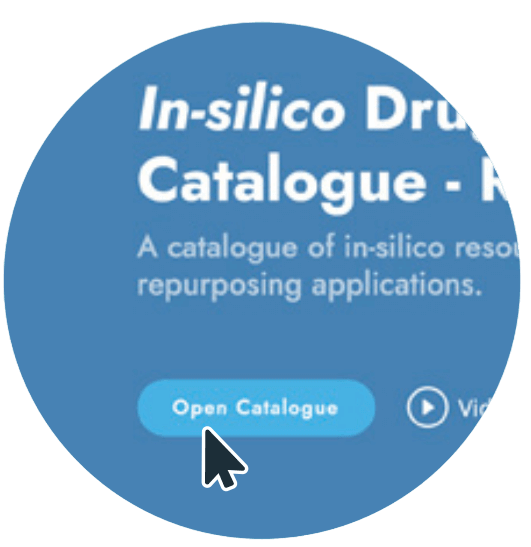
- Go to the landing page and click on open catalogue.
- Choose either databases or tools and methods.
- Choose a database depending on your interests.
- Follow the instructions of the database of your choice e.g. ChEMBL, Alphafold2, Open Targets.
iDRC-R4ALL contributors
WHAT IS THE IN-SILICO DRUG REPURPOSING CATALOGUE?
Made by an expert panel of 26 REMEDi4ALL network members alongside scientists from across Europe, the REMEDi4ALL in-silico drug repurposing catalogue is an online collection of relevant tools, databases and methods which are related to the drug repurposing pathway. It can be described as a ‘one-stop shop’ for academic researchers and industry professionals looking for scientific information relating to drug repurposing.
The catalogue compiles open access databases on patient data from diseases including cancer (e.g. ICGC ARGO), drug-target interactions (e.g. BindingDB), activity (e.g. Clarity) and disease interactions (e.g. Clinical trials), links between genes and diseases (OpenTargets) as well as general information on cell lines (e.g. Cancer Cell Line Encyclopedia (CCLE)), protein (AlphaFold) and chemical structures (e.g. ChemSpider), pathways (e.g. KEGG) and toxicities (e.g. CompTox). In addition to databases, the catalogue also houses tools and methods on docking (e.g. Autodock), modelling (e.g. I-Tasser), binding sites (e.g. PyMOL) and predictions.
WHERE CAN YOU FIND THE PLATFORM?
The platform is freely available online at the following link: https://www.idrc-r4a.com/
WHY IS IT USEFUL?
iDRC-REMEDi4ALL is a useful tool for both basic research and clinical applications as it combines a wide variety of databases on small molecules with patient databases and disease interactions into a single platform of relevant, open access drug repurposing resources.
Within the catalogue, available databases, methods, and tools can be used in a range of drug repurposing applications.
DATABASE, TOOLS AND METHODS
DRUG REPURPOSING APPLICATIONS
| Drug repurposing by finding new gene-biomarker, new variant-disease associations | Identification of new target indications, biomarkers and drug-disease links |
| Structure- and target-based drug design/repurposing | Prediction of drug sensitivity, response, target activity, synergy, combination, toxicity |
| Mapping disease pathways | Drug response, resistance and toxicity testing |
| Prediction of drug combination dose landscape | Drug similarity analysis |
| Predict new disease associations for miRNAs | Design of new clinical trials and prediction of clinical trial outcomes |
| Drug target prediction using RNA-Seq data | Gene essentially prediction |
The catalogue allows you to choose the best databases, tools and methods in line with your requirements using the following categories:
- Drug repurposing application
- API (application programming interface)
- References
- Median rating
- Number of votes from users
QUICK START GUIDE
- Go to the landing page and click on Open Catalogue.
- Choose either databases or tools and methods.
- Choose a database depending on your interests.
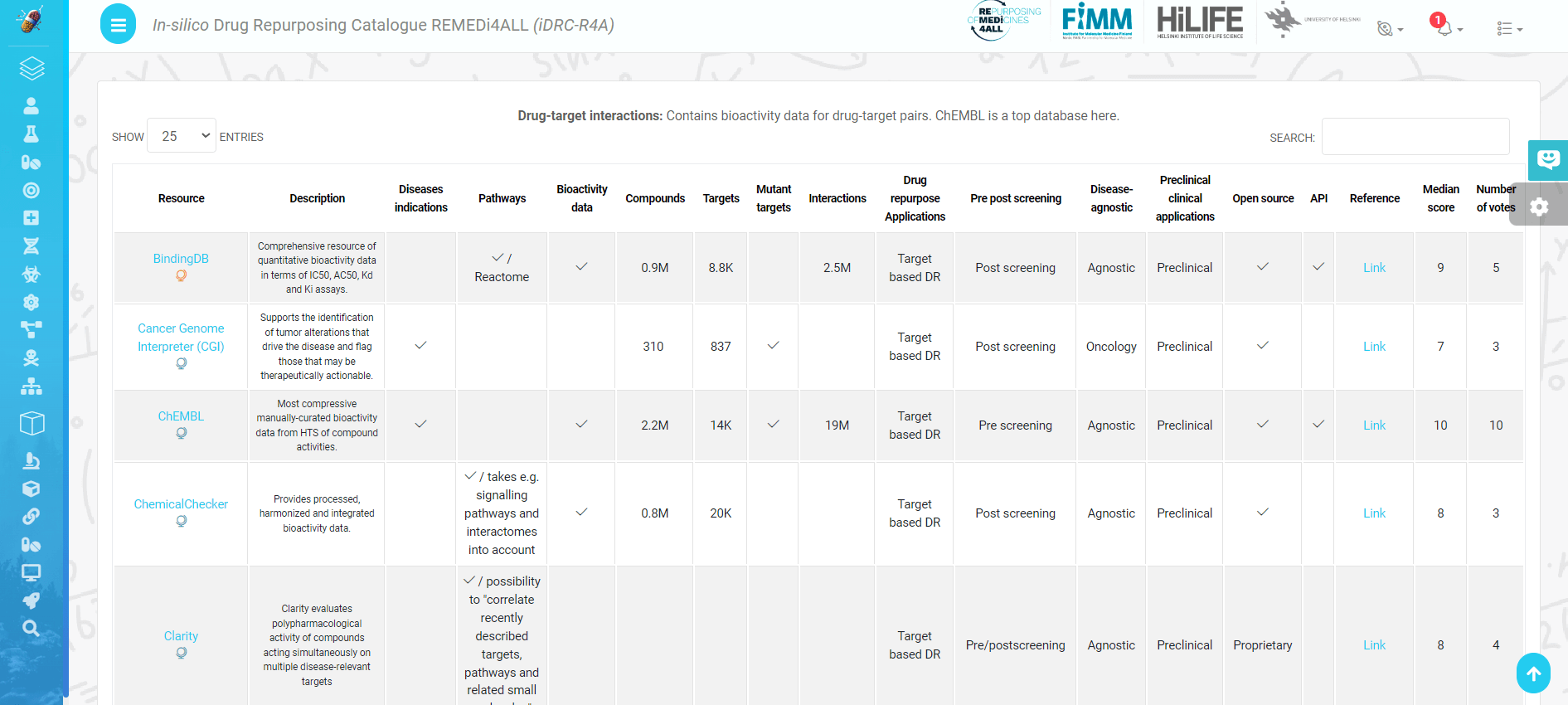
Example 1: searching by drug-target interactions
- Under databases click on drug-target interactions.
- Choose a resource according to your requirements and provided categories (disease indications, pathways, bioactivity data, compounds, targets, mutant targets, interactions, pre/post screening, disease-agnostic, preclinical/clinical applications)
- The database (e.g. ChEMBL) will open in a new tab.
- Input the name of the drug/small molecule/compound into the search bar and explore relevant properties and indications for your research.
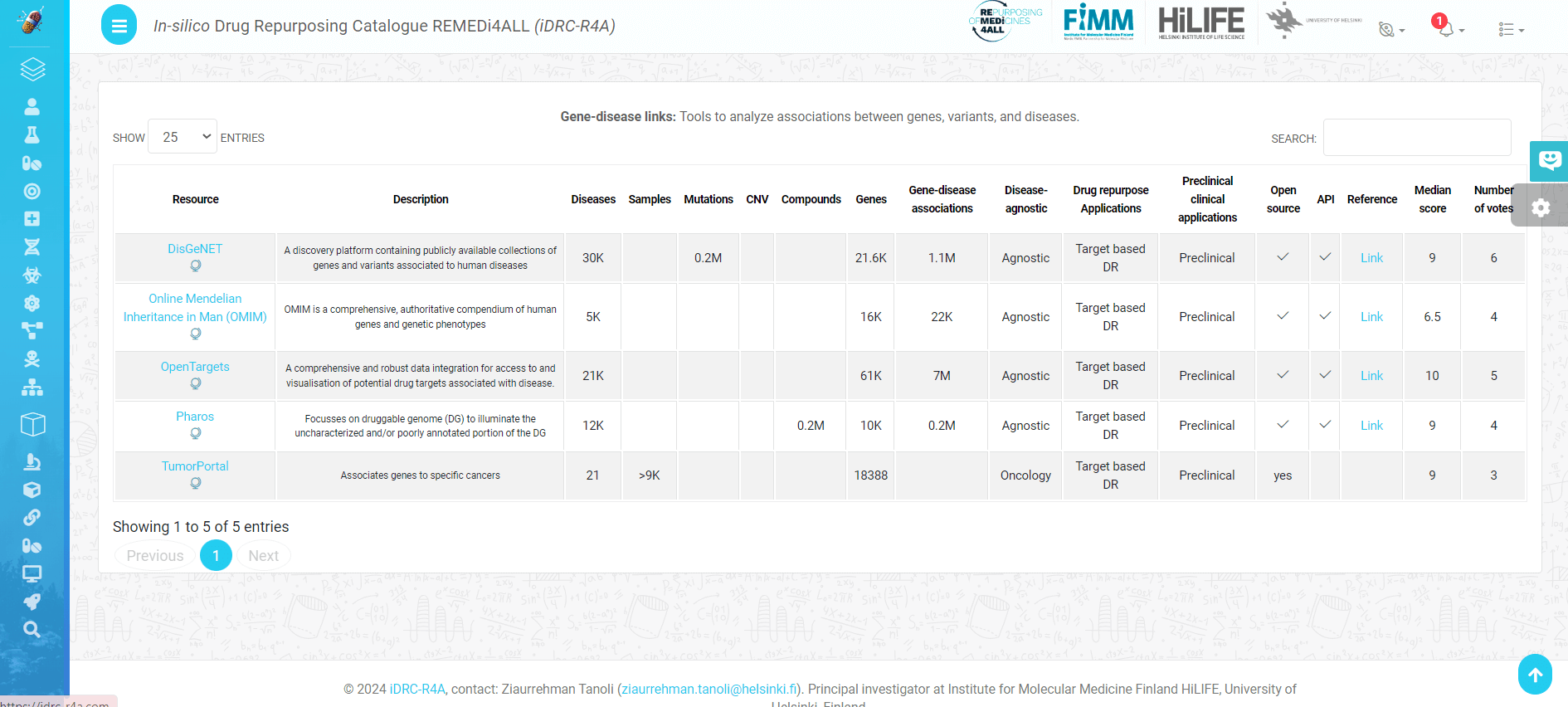
Example 2: searching by gene-disease interactions
- Under databases click on gene-disease interactions
- Choose a resource according to your requirements (number of diseases,samples, mutations, CNV, compounds, genes, gene-disease associations, disease-agnostic, preclinical/clinical applications).
- The database (e.g. Open Targets Genetics) will open in a new tab.
- Input the name of your gene, variant, study, or trait of interest and clicksearch
- Extract the relevant information for your research.
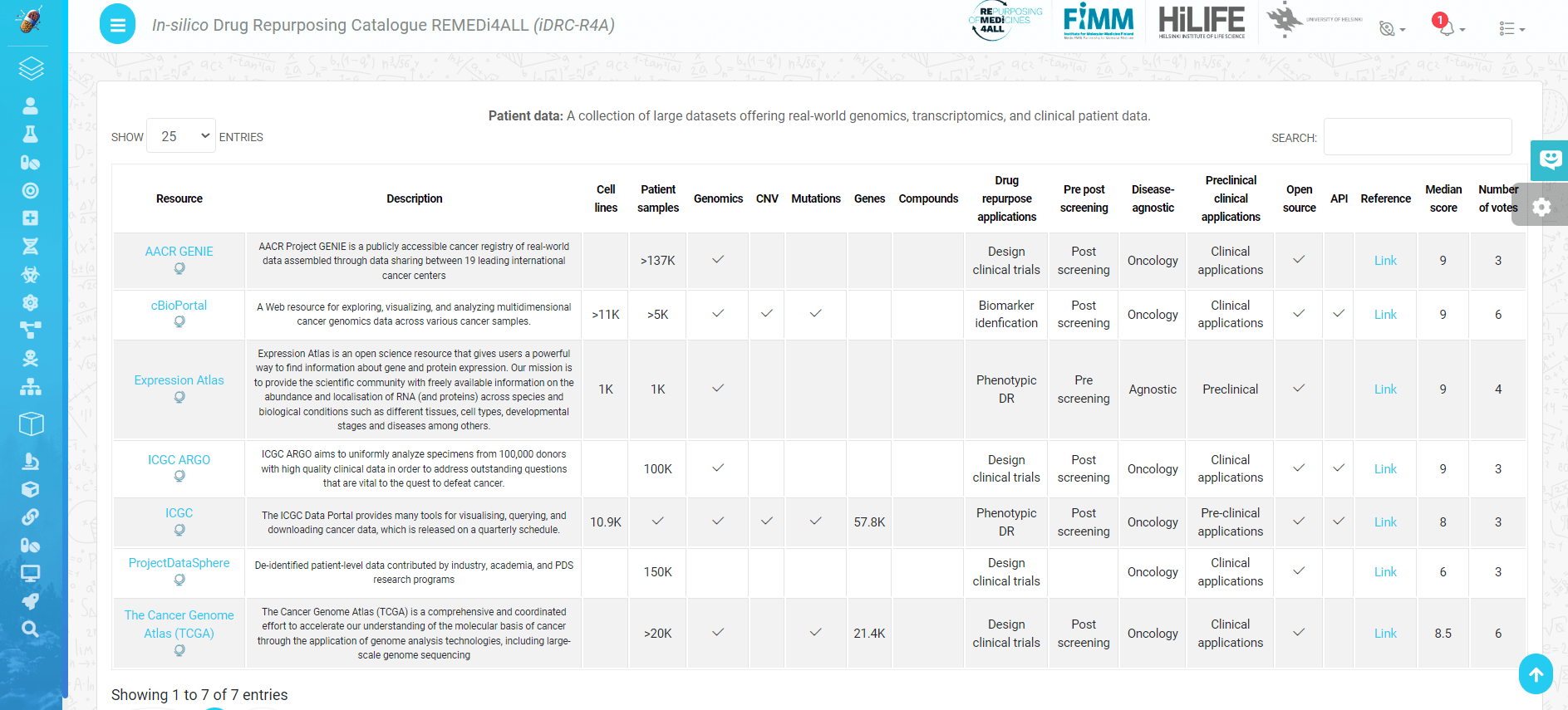
Example 3: searching by Patient Data
- Under databases click on patient data.
- Choose a resource according to your requirements (number of cell lines, and patient samples, genomics, mutations, CNV,compounds, genes, disease-agnostic, preclinical/clinical applications).
- The database (e.g. cBioPortal) will open in a new tab.
- Search by study data or disease (cancer genomics databases are most widely available within catalogue currently).
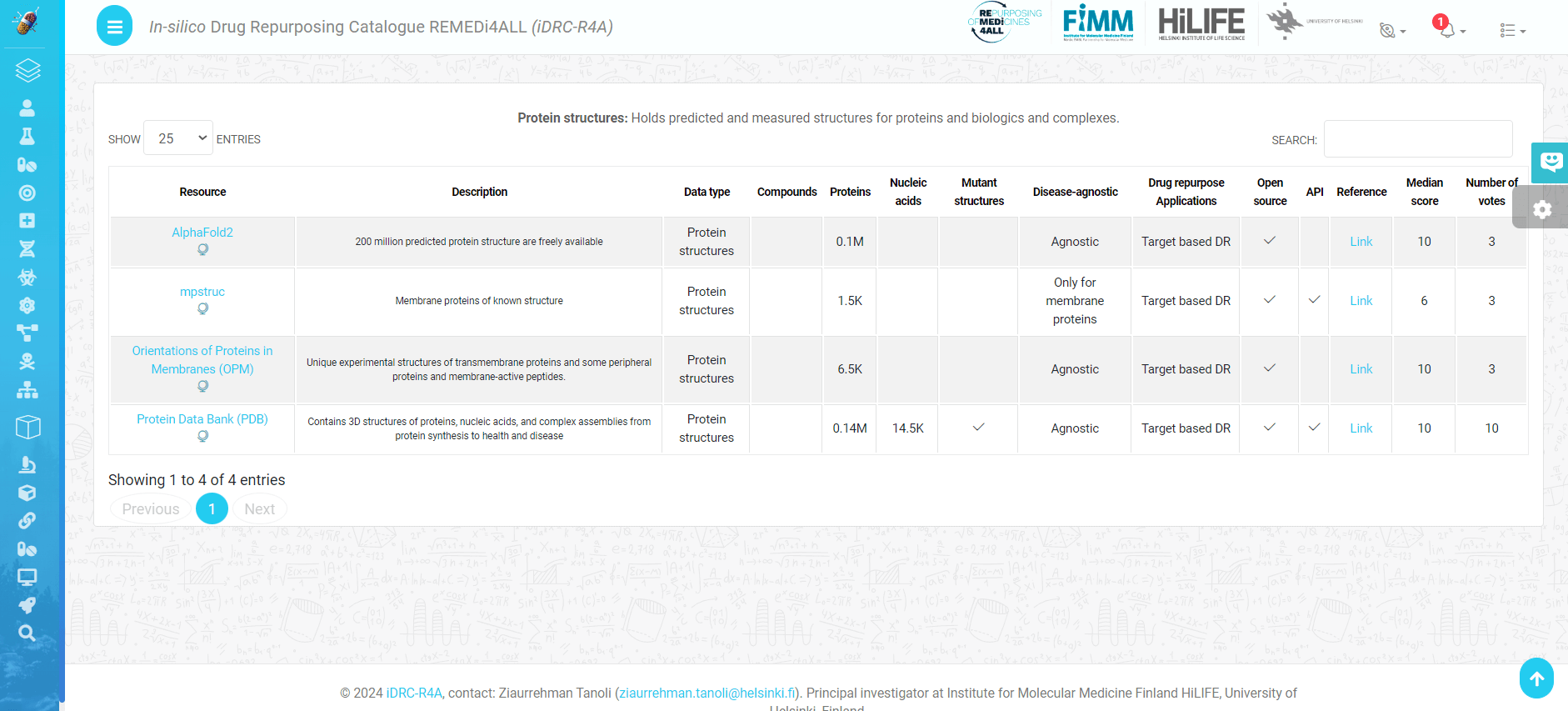
Example 4: searching by Protein structures
- Under databases click on Protein structures.
- Choose a resource according to your requirements (data type, compounds, number of proteins and nucleic acids, mutant structures, disease-agnostic).
- The database (e.g. Alphafold2) will open ina new tab.
- Search by protein of interest to view interactive model (human, mouse etc.) with information on code, structure etc.
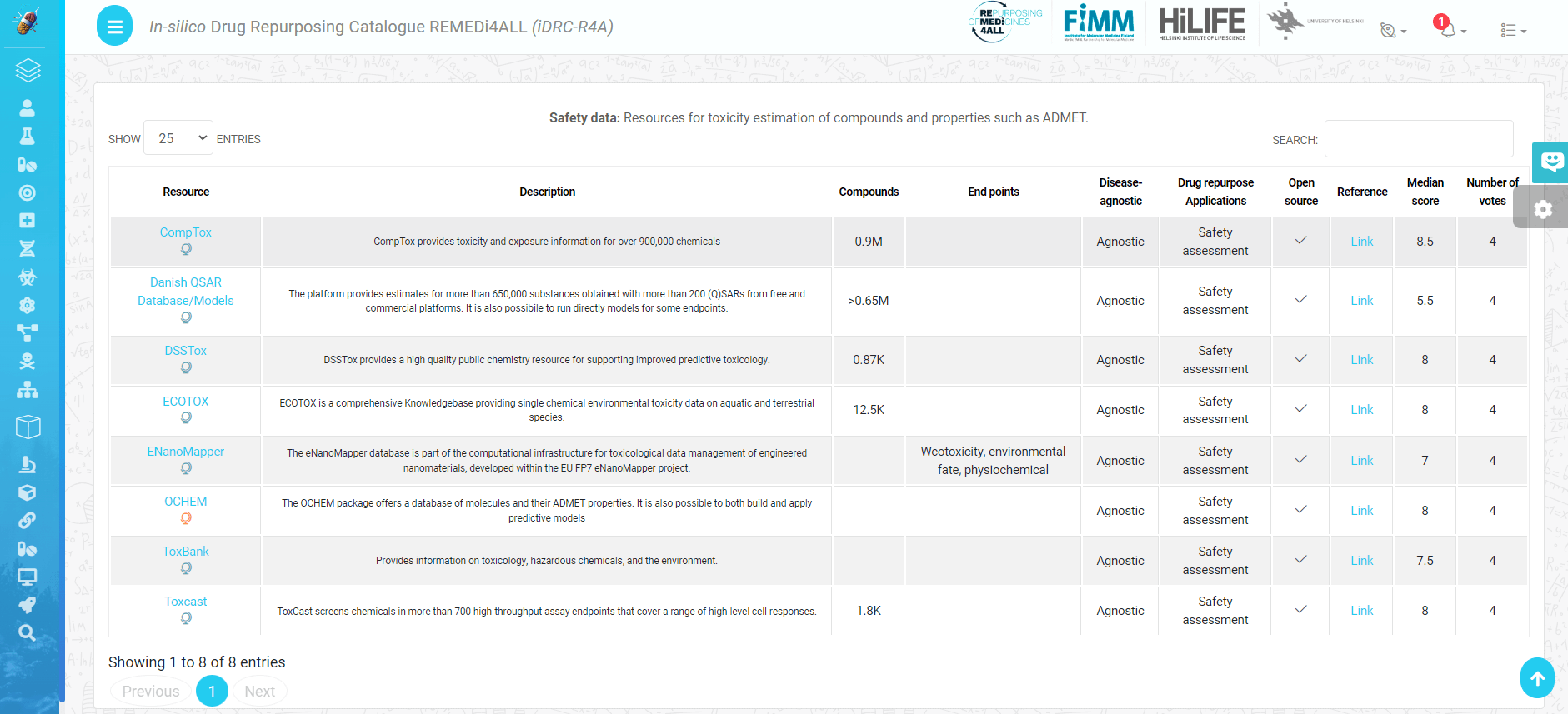
Example 5: searching by Toxicities
- Under databases click on Safety data.
- Choose a resource according to your requirements (number of compounds, endpoints, disease-agnostic).
- The database (e.g. CompTox) will open in anew tab.
- Search by chemical of interest to find information on properties, quality control,structure, linked substances, and recorded information on use as a drug.
ABOUT REMEDi4ALL AND ITS VISION FOR DRUG REPURPOSING
Drug repurposing aims to find new uses for existing medicines to treat conditions with unmet medical needs. This developing field has the potential to be less costly and significantly quicker than traditional drug discovery. This makes it a valid, attractive strategy especially for rare and neglected conditions, cancer or emerging public health threats such as COVID-19. Yet, numerous barriers — economic, regulatory, policy — and inefficiencies — fragmented ecosystem, lack of patient centricity in the research process — are still holding back drug repurposing.
Now, with the backing of the European Union, REMEDi4ALL is set to revolutionise the repurposing landscape in Europe by developing a harmonised, accessible and patient centric platform. This will provide the expertise, tools and resources required in every stage of this complex process.
REMEDi4ALL is enabling innovative drug repurposing through:
- a comprehensive, standardised platform served by experts in all facets of the repurposing journey
- a supportive policy context
- a dynamic global community practising drug repurposing
to ensure that more (and better) repurposed medicines are available to patients and contribute to more sustainable health systems. The unique combination of expertise that the 24 partnering organisations bring to REMEDi4ALL represents the best chance of success in making drug repurposing the new normal.
Contact
Ziaurrehman Tanoli (ziaurrehman.tanoli@helsinki.fi)
Principal investigator at Institute for Molecular Medicine Finland
HiLIFE, University of Helsinki, Finland.
Location:
Tukholmankatu 8, Helsinki, Finland
For any questions:
ziaurrehman.tanoli@helsinki.fi